We are all historians of the AI Age: ai Storians
Prologue:
In August 2016, a package arrived at a small nonprofit research lab in San Francisco.
The delivery man was unusual. A guy in a black leather jacket, carrying the box himself. His name was Jensen Huang, CEO of Nvidia.
Inside the box was the world’s first AI supercomputer, the DGX-1. Huang took a marker and wrote on it:
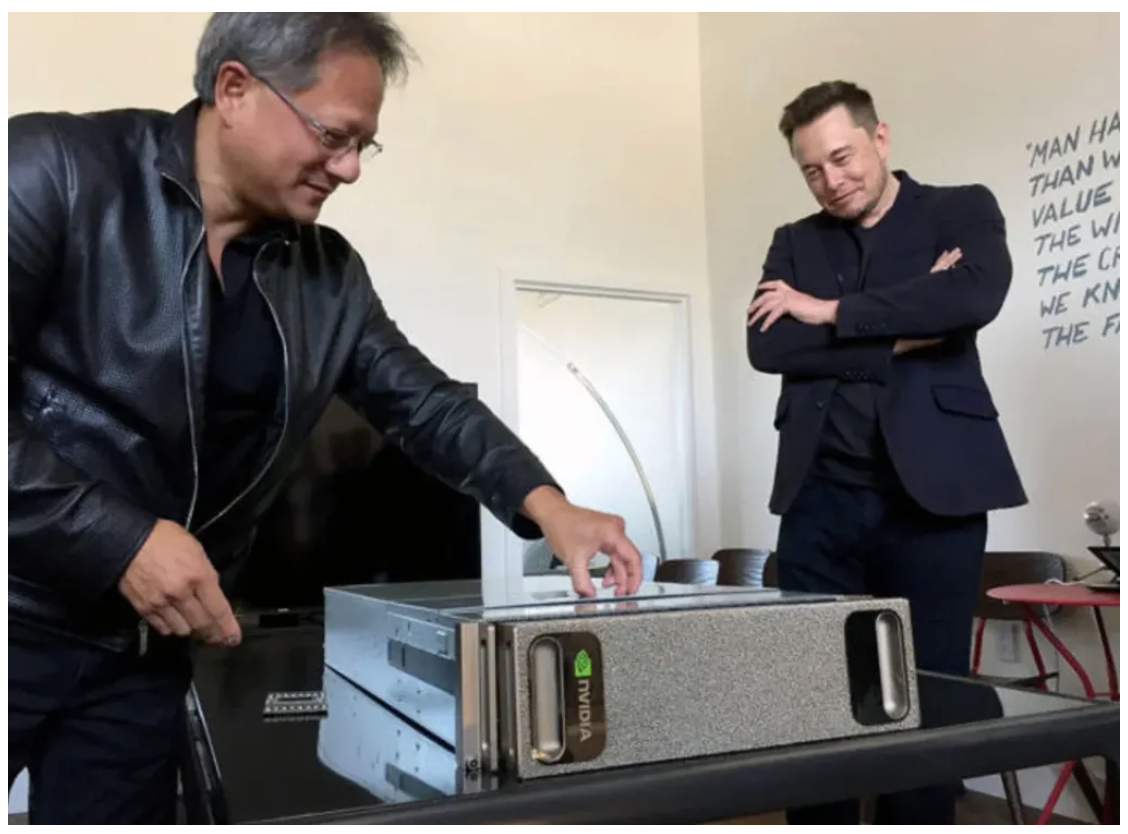
Jensen Huang presenting DGX-1 to Elon Musk
To Elon and the OpenAI Team!
To the future of computing and humanity.
I present you the world’s first DGX-1!”
This tiny research lab was called OpenAI.
Six years later, this lab released ChatGPT in November 2022.
And the world has never been the same.
Now, a question.
What did that computer actually do? Did it compute the future?
No. The exact opposite. What that computer did was read the past.
It read decades of human writing piled up on the internet: posts, conversations, records. It read them day and night, again and again. That’s what “training” means.
And this training process ran on Nvidia’s GPUs, and Nvidia became the most valuable company on Earth.
Here is the great paradox of the AI age.
AI is the most future-facing technology in human history.
And its foundation is 100% history.
It’s written right into the name. Did you know GPT stands for Generative Pre-trained Transformer. The P in the middle: pre-trained. Trained in advance. On what? On everything humanity has recorded so far.
The history is baked into the very name that opened the AI age.
How it works is just as simple. Inside mountains of data, the model runs hundreds of millions of patterns at terrifying speed to predict one thing: what comes next. Reading what came before, to guess what comes after.
Wait. That sounds awfully familiar.
Someone who reads the records of the past, finds the patterns, and predicts what’s next. A historian.
We already have a name for all that data. We call it the past. We call it history. Which means the technology building our future is nothing, absolutely nothing, without History.
Some sixty years ago, the historian E.H. Carr defined history as “History is an unending dialogue between the past and the present.”
Now plug today’s AI era into that sentence.
The data is the past.
The prompt you type is the present.
And the output is the future.
AI is a technology that turns the unending dialogue between past and present into the future. And here’s the twist: that past is running out.
Epoch AI research group projects that within a few years, AI will have read basically all the public text humans have ever put on the internet. Records that took humanity thousands of years to write, read by machines in about ten. Which is why AI companies are now spending billions of dollars on new data. That is, on new records.
Think about what that means.
Data, records, stories, history: they are becoming the most precious raw material, a foundation of the AI age.
And apparently, willingly, we contribute to this every day. Every prompt you type, every conversation you have with an AI, every post you write and photo you upload. You are creating new data. You are writing new history.
Which makes us all historians of the AI age.
But here’s what really matters. While we contribute, we don’t feed the machine for its sake. We record things for our purposes, our goals, our lives. That’s not just history. That’s our history. And there’s a word for one’s own history: a story.
So we shouldn’t settle for being AI’s historians. Be the person who turns records into stories. That’s how this name was made: (ai) storians.
This letter is not going to cover each AI model’s benchmark. The world where last week’s best model becomes this week’s runner-up is covered plenty elsewhere. And frankly, most people don’t care.
Here we cover something more important:
How to survive, and shine, as a storian of the AI age. What doesn’t change while everything else does. What AI cannot replace, no matter how good it gets. And why exactly those things will become more valuable.
Follow this series and you’ll walk away with three things.
One. The list of things AI cannot do, and how to become irreplaceable by standing on it.
Two. A lens for reading the AI era: seeing trends, industries, and investments one step earlier.
Three. How to use AI as a storian: getting the most out of the machine while staying the one thing it can’t generate.
Use AI well, and you can be a top 1% talent.
Become someone AI can’t replace, and you can be a top 1% talent.
Do both, and you’re in the top 0.1%. That’s who will own the AI age.
At one point in our lives in the past 4 years, we have asked one of these questions:
Should you still study languages in the AI era? Do music lessons matter? Sports? Should you learn to code? Is college worth it? What should we teach our kids? Who survives in this world, which skills matter, and which companies will still be standing?
If you read this letter, you will find the answers to these. And you will be able to prepare accordingly.
(ai)storians is our story. That’s why it’s Storians, plural, and not Storian.
Because all of us are storians.
Welcome to (ai)storians.
— JKIMMORGAN , ai storian