Be a Messenger
“The medium is the message.”
— Marshall McLuhan
Messenger — In the AI era, the person who delivers information with their name and face attached. Trust and accountability are the signature AI cannot generate.
AI user vs AI consumer — Users assign jobs to models, control errors, and build feedback loops. Consumers make small talk with chatbots.
AI is moving too fast. The world is changing even faster.
Last week’s best model is this week’s runner-up. Claude for a while, then GPT, and wasn’t there a Kimi week in there somewhere?
So here’s a question. Inside this wave, what exactly are we doing?
New models, new benchmarks, new leaderboards.
Every week, the experts crown “the best model right now.”
Parameters this, fine-tuning that, this one reasons differently. Something about tokens.
They say the grid is running out of power. Is that why my electric bill looks like that?
And on top of the noise, the experts stack fear.
Fall behind on AI and you’re left behind.
Fail to use it and you’re finished.
But run the numbers. The people who truly understand AI are less than 0.1% of the world. Most people still can’t understand it like an expert, wield it like an expert, or build anything serious with it.
So the fear has a math problem. If the fear is right, everyone except the 0.1% should be doomed.
Are they?
“I’m fine. I use GPT, Gemini, and Claude. That puts me in the 0.1%, right?”
I’m sorry. It doesn’t.
Planning a trip with ChatGPT. Asking it for your horoscope. Running translations. Polishing emails. That isn’t using AI. That’s making small talk with it. Talking to AI and putting AI to work are two different things.
Don’t take my word for it. OpenAI teamed up with economists, analyzed the messages of 700 million users, and published the results itself. About 80% of ChatGPT usage was advice, information lookup, and writing.
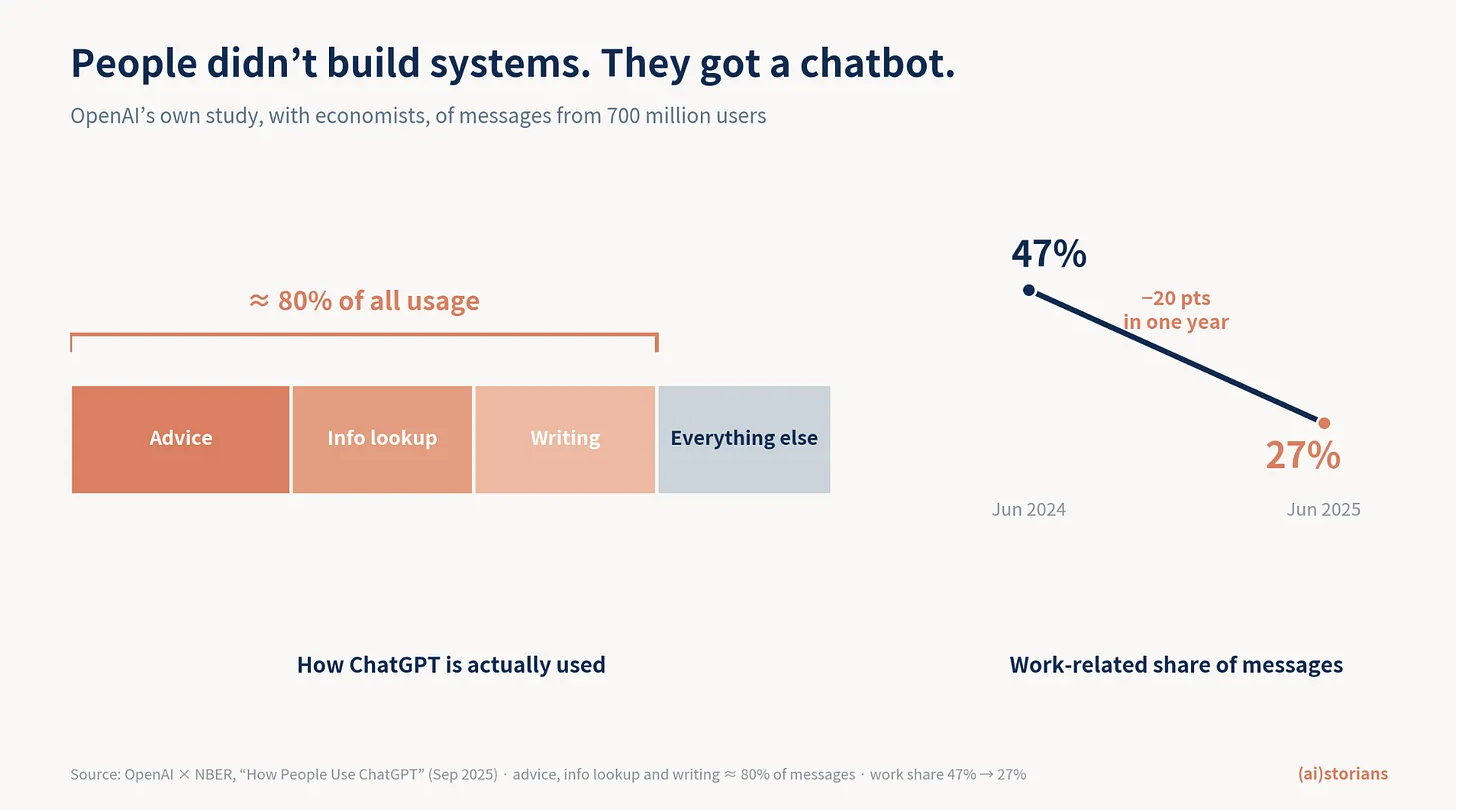
The share of work-related messages actually fell from 47% to 27% in a single year. OpenAI admitted, in its own study, what most of us suspected: people didn’t build systems with AI. They got a chatbot that suits them.
The real 0.1% moves differently. They know each model has its own character and strengths. They assign different jobs to different models, optimize token spend, control for errors, and design feedback loops that tighten the system until the output is exactly what they wanted.
Those are AI users. The other 99% are, cold as it sounds, AI consumers.
And we consumers found our own workaround: the brokerage account. The AI stock frenzy was never just about making money. Underneath runs a quieter logic: “Even if I can’t wield AI, my AI stocks can profit from it for me.”
So is that the answer? Is buying AI stocks the only way for the rest of us to survive the AI era?
Except the stocks we trusted are wobbling too. Samsung, SK Hynix, Micron, Nvidia. The untouchables, suddenly touchable. The July 31 rebound was beautiful, but most accounts are still bruised.
And every dip makes the anxiety louder.
This letter is for exactly these people. (ai)storians is a refuge and a way through for the 99%. A letter for people who keep being told to fear the AI era, and never told how to live in it.
So what should we, the 99%, do?
Go AI-obsessed like the 1%?
That’s one answer, and a real one. Join a bootcamp. Take a vibe-coding seminar. Grind through Anthropic Academy. The road to becoming an AI user is open. But even that road guarantees neither success nor safety.
And what if AI just isn’t your thing?
Master the law and you’re set for life. Who doesn’t know that?
Speak a second language like a native and doors open. Who doesn’t know that?
Be great at sports, great at singing, and everyone loves you. Who doesn’t know?
Nobody does all of it. You get one body and 24 hours.
Long before AI, we were already doing the rational thing: learning new skills to raise our value, in whatever field overlapped most with our goals and interests. So “go all-in on learning AI” cannot be the only answer, not for people whose talent and curiosity live somewhere else.
There is another answer. There are fields and industries that the one-way watchers, the AI-fluent tech crowd, cannot see from where they stand.
Master the territory AI cannot touch, and you won’t just survive the AI era.
You can rule it.
There’s evidence. The people demonstrating this shift, remarkably, are the very people building the AI era. I don’t know how many have caught the current yet. But this may be the most important shift in AI, maybe in the entire history of business. While everyone around us cranks up the AI FOMO, the bigger story is slipping right past.
That story is today’s episode, and the starting point of (ai)storians.
The skills, the people, the companies that will survive the AI era.
No. That will rule it. What do they look like?
Let’s take it step by step.
Messenger is the Message: Trust and Accountability
In the AI era, the messenger becomes more important than the message. The more common messages become, the more precious messengers become.
Sixty years ago, McLuhan told us the medium is the message. The AI era has an update ready: the messenger is.
The Reuters Institute’s 2026 report found trust in news at its lowest point since tracking began in 2015. The same report found that 27% of respondents worldwide now get their news from individual creators. The trust draining out of institutions is pooling around individual faces.
It’s the same reason reaction videos and commentary outperform the original footage. Information is already everywhere, so we want information that has passed through someone we trust. We want someone to do some of the thinking before it reaches us.
But why does the messenger overtake the message?
Because in the AI era, what we demand from the person delivering information is not knowledge. It’s two things: trust and accountability. And those two things are exactly what AI cannot replace.
Trust. The AI era is the era of doubting everything.
This article, that video, that voice: any of it could be AI-made. In a world like that, “who said this” is the last signature left on content. The credibility of the messenger starts to outweigh the credibility of the information.
Accountability. AI signs nothing.
But someone has to. AI just runs, shuttling between data centers, burning an invisible fuel called tokens, producing outputs. Those outputs never reach the world unless a human intends them to. And whoever intends it, owns it.
Which is why, at the very height of the AI age, we want trustworthy humans more than we ever have.
A world where the messenger is the message.
That is the world AI is bringing.
And the people proving it in real time are the people building the AI era with their own hands.
Becoming a Messenger: The Executives Stepping Forward
1. Jensen Huang
July 24, 2026. Jensen Huang opened an X account.
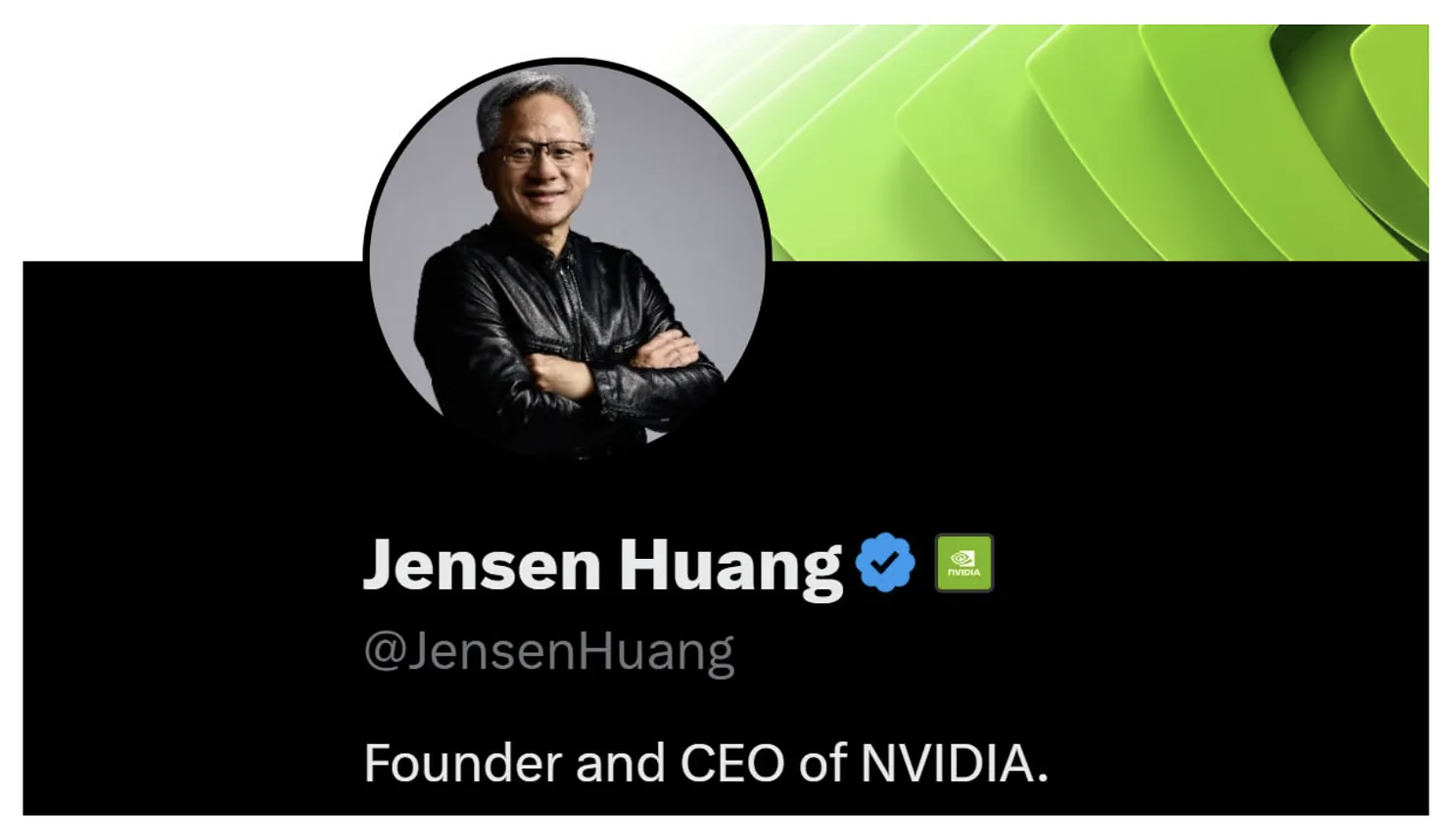
This is a man who ran a company for more than 30 years without touching social media. While the CEOs of Intel and AMD posted busily for years, he alone stayed silent. That man collected 10,000 followers within 20 minutes of showing up. And his first post wasn’t a product ad. It was a policy letter on why open models matter.
The CEO of one of the most valuable companies on Earth decided, now, to start speaking directly.
He wasn’t selling GPUs. He was sharing how the man building the AI era sees the AI era.
2. It’s not just Jensen. Satya Nadella, CEO of Microsoft.
This year Nadella opened a personal blog called SN Scratchpad and started publishing essay after essay. Across channels, too: every Nadella essay lights up X and LinkedIn. “2026 is the inflection point of AI.” “We are paying twice for intelligence, once with money, once with our knowledge.” Each post made the industry sway.
Now, a question. Microsoft has one of the finest communications organizations on the planet.
So why is the CEO writing under his own name, on a personal blog?
And two weeks after Nadella’s essay on token capital, Jensen Huang appeared on X.
Coincidence?
3. It’s not just tech CEOs, either.
The tech CEOs are actually the late arrivals. For a while now, heavyweight figures have been putting their names and faces on social media, not legacy media, and their influence keeps compounding.
Ray Dalio, 76, founder of Bridgewater, the legendary hedge fund. This June he published another long essay on the changing world order. His newsletter has 750,000 subscribers.
And just days ago, on July 27, reports broke that Bernard Arnault had joined X. Chairman of LVMH. The richest man in Europe. 77 years old. The man who owns Louis Vuitton and Dior now wants to speak for himself on social media.
These are people who literally do not need the money. And yet here they are, trying to deliver something, with their names and faces attached.
Once you notice the current, the next story becomes impossible to wave off.
4. The Burger Battle

In February, the CEO of McDonald’s posted an Instagram video of himself eating a new burger. He took a bite so small, and kept calling the burger “the product,” that the entire internet turned him into a punchline.
The fun part is what happened next. Do you know how Burger King responded? With a video of its own boss taking a huge, satisfying bite of a Whopper. And McDonald’s flipped the crisis into an opportunity with a deft PR response: the CEO leaned all the way into the awkward persona, and people liked him more for it.
CEOs, with their faces on the line, in a burger-eating duel. That’s the era we’re in.
In the AI era, the protagonists are no longer brands or companies. They’re humans.
The messenger is the message.
People began quietly demanding trust and accountability.
The executives who noticed didn’t send a press release. They moved in person, fast.
Heads of trillion-dollar companies. The people whose hours cost more than anyone’s on Earth. People with unlimited access to PR teams, spokespeople, and agencies. All of them, at once, started speaking under their own names and faces.
Jensen Huang. Satya Nadella. Nobody understands AI better than these people.
Nobody is more directly building the AI future.
And they are showing us, in real time, what that future makes scarce.
It comes down to Human Capital. Not humans in general.
A human we can trust. A human who will answer for the outcome.
Conclusion: To Win in the AI Era, Be a Messenger
The irony of AI is that the better it gets, the more AI itself becomes a commodity.
Today’s prompt trick is tomorrow’s default feature. As the models improve, your hard-won AI skills decay into factory settings. And when access to information flattens, the price of the message falls.
The power users carry their own paradox, a fear buried deep: the better they use AI, the better AI gets trained, and the faster their edge dissolves into it. We’ve seen this movie. Five years ago the world had a coding boom, and people lined up for bootcamps. Coding was the first thing AI replaced. Today’s hottest skill is “AI.” The thought that even that can be replaced is the era’s greatest fear, and its neatest irony.
Which is what those executives are actually demonstrating: “I cannot be replaced.”
They understand that the most powerful capital in the AI era is the self. Human Capital.
Jensen Huang, who is building the era. Bernard Arnault, who has nothing left to prove. Even they are becoming messengers.
Not despite the AI era. Because of it, the message has to carry your name.
That is how the rest of us make it. The lines outside vibe-coding classes are long. Even the people standing in them may not survive without becoming messengers.
Information is cheap. Access is nearly free.
Interpretation is expensive. Trust is the most expensive. Accountability is priceless.
The 1% builds the technology. Let that be their game.
There is another game, and it’s open to the 99%.
If you want to survive the AI era, no, if you want to shine in it:
Be a messenger.
How do you start?
Start by reading (ai)storians.
Why are CEOs going on social media?
As AI makes information abundant, a CEO’s name and face create trust and accountability around the message. Jensen Huang and Satya Nadella show how leaders become messengers when people need a human answer for the direction of technology.
What can AI not replace?
AI cannot replace Human Capital: a human we can trust, who will answer for the outcome. It can generate content, but it cannot generate a lived reputation or accountability.
How do I start becoming a messenger?
Put your name and face behind what you know, publish consistently, and answer for the results. Start with one clear point of view and build a feedback loop with the people you serve.
What is an AI user vs an AI consumer?
AI users assign jobs to models, control errors, and build feedback loops; AI consumers make small talk with chatbots. The user treats AI as a tool to direct and evaluate, not as an answer machine.
— JKIMMORGAN, (ai) storian