Create a Tradition
What if I told you there is a sports brand that refuses to make more money and go viral?
It happens to be one of the most famous tournaments on Earth.
TV ads? Four minutes an hour. A third of the American sports average.
Sponsor signage? Not one board, anywhere.
Ticket hikes? Never. Face value stays the same.
Concession Food? A sandwich costs $1.50. Frozen for decades.
They even take your phone away. In 2026. How do you expect to go viral with that approach?
If you run a business or marketing this way, you should go broke.
Except the waiting list for tickets closed in the 1970s. It has never reopened. Some people have been in line for half a century. That $140 ticket trades for thousands of dollars on the secondary market. It generates the most viral media buzz and stories in the profession. It also makes $200M in revenue during just one week of the tournament.
The Masters Tournament. A golf event that started in 1934.
Why does a letter about AI talk about a golf tournament? Hear me out.
In an era where AI is replacing everything, this old, analog, stubborn tournament isn’t going anywhere. Rather, it is pulling away from the other three majors and becoming the most precious event in golf. And this needs to be studied. So I did it for you.
The 2025 final round of the Masters peaked at 19.5 million viewers, the best since 2018. The other three majors draw 4 to 6 million for their finales. You have to add all three together to approach the Masters. And the Masters doesn’t even spread its broadcast across multiple networks.
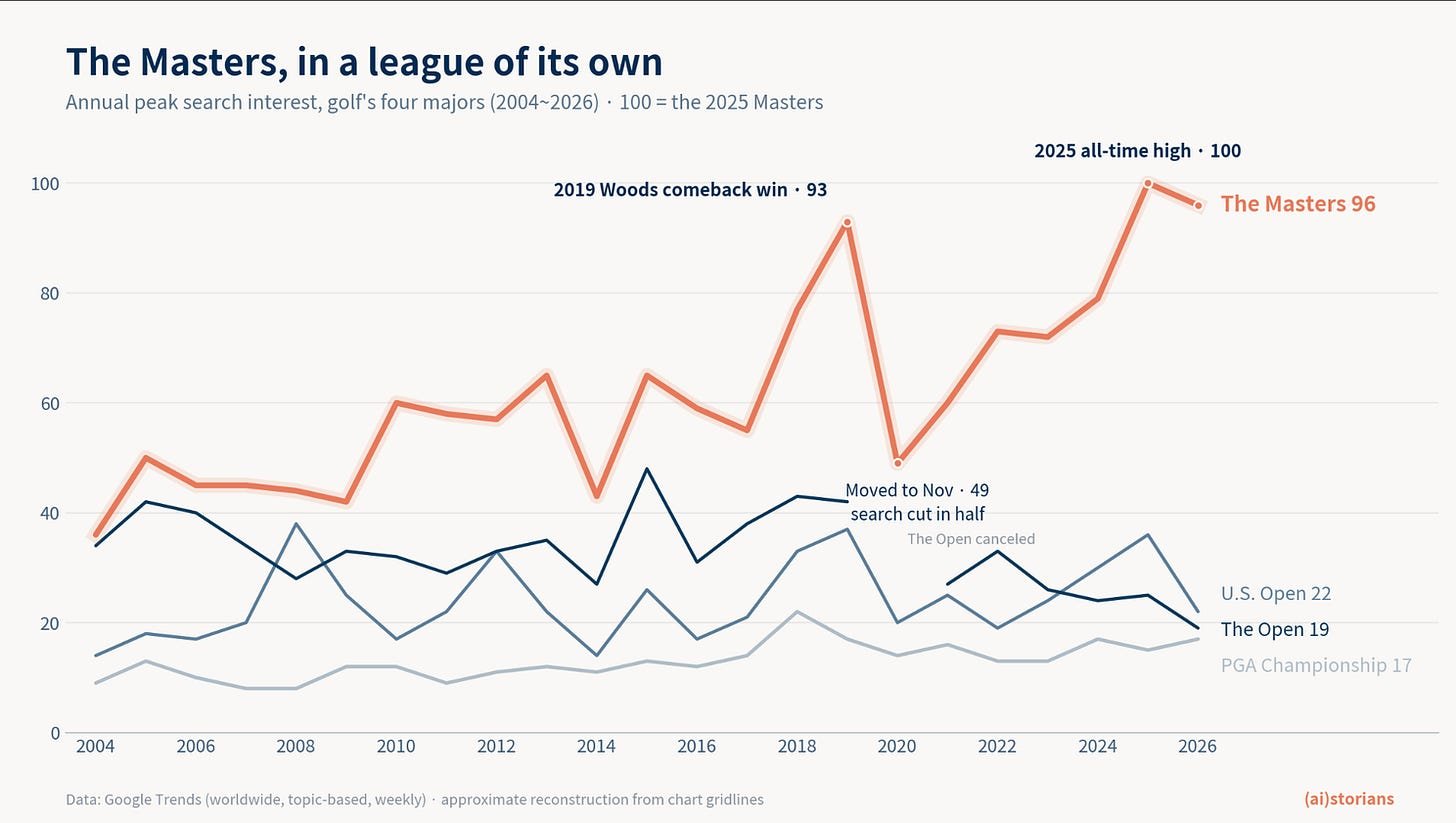
On Google Trends, averaged over the last 22 years, the Masters alone matches the other three majors combined. The gap widens every year.
And the biggest search year in history wasn’t 2019, when Tiger Woods completed his comeback, “the Return to Glory.” It was 2025. The tournament has become bigger than Tiger Woods, the Mr. Golf himself.
Last letter was about the person AI cannot replace. This one is about the brand AI cannot replace. The brand that gets more loved the more artificial the world becomes.
The answer wasn’t in Silicon Valley. It was on a golf course in rural Georgia, a town called Augusta.
So how on earth did they do it?
1. Branding Obsession Creates a Universe
The course is called Augusta National Golf Club. A dream course for any golf enthusiast. For just one week in April, every year, the attention of the sports world funnels into it.
Here, you don’t call spectators “fans.” They are patrons.
You don’t call the rough “rough.” It’s the second cut.
This isn’t an in-house quirk. It’s a language rule the broadcast networks must follow. Even the players use these words.
About those broadcasters: the Masters has worked with CBS for 70 years on what are effectively one-year contracts, renewed one at a time. Even one of the biggest networks in the world is kept in permanent tension as a “vendor.” If the quality slips, there is no next year.
And here comes the least believable number about the Masters:
The Masters charges CBS nothing. Zero dollars in rights fees.
While the U.S. Open collects $93 million a year for its American TV rights alone, the Masters gives away a broadcast worth an estimated $125 million a year for free. CBS actually sends Augusta a production bill (about $10 million), and a handful of sponsors cover it. By Forbes’ estimate, the money this club deliberately chooses not to earn comes to roughly $300 million every year.
It looks insane. The entire business of sports is built on selling broadcast rights. But in exchange for free, everything on the broadcast follows Augusta’s rules. The moment you have a master, you lose control of your own brand.
Watch how detailed that control goes. At Augusta, nearly everything you can see is green.
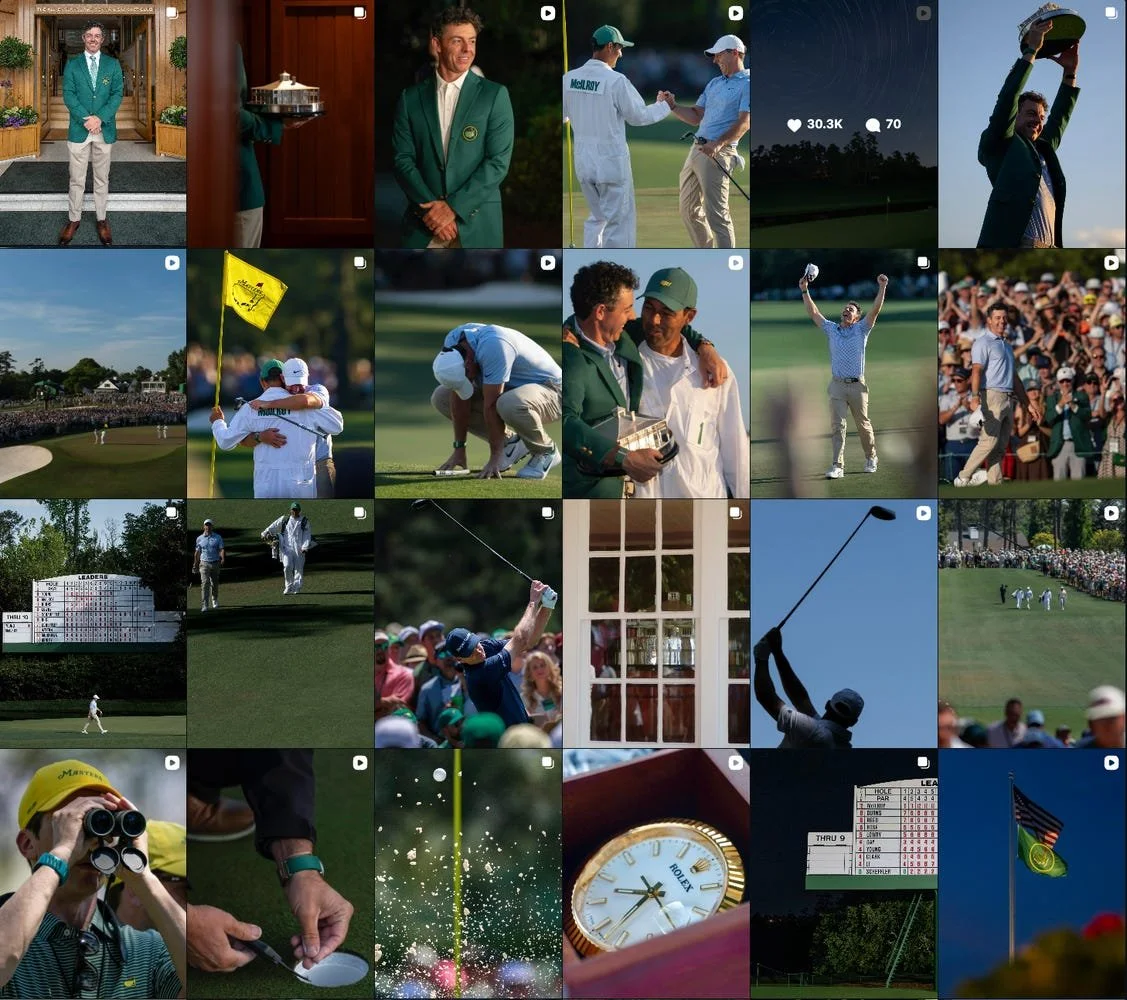
(image: @themasters)
The trash cans are green. The trash bags inside them are green. The camera towers are green. The folding chairs are green. Even the sandwich wrappers are green, so a dropped one disappears into the grass instead of showing up on TV.
The seed used to fill divots is dyed green before it’s spread. The ponds look impossibly dark because the club tints the water with a food-grade dye. There was even a legend that Augusta lays ice on the azalea beds to time the bloom for tournament week.
That one turned out to be false. But the fact that the rumor sounded plausible tells you what level of obsession this club is famous for.
The Masters chose control over money. For 70 years straight.
Why go this far? Because obsession at this level builds something beyond branding. It builds a universe, a cult.
There’s a classic in consumer research. Muñiz and O’Guinn’s “Brand Community” study (2001) found three markers of a strong brand community: a shared sense of us, rituals and traditions, and a sense of duty among members. And the glue holding it all together is insider language.
“Patrons” and “second cut” aren’t rules. They’re rites of entry. Say the words and you stop being a spectator and become an insider. Their own lingo, words that exist only there, taboos that hold only there. Stack them for decades and you have the Masters universe.
In the AI era, AI can imitate your branding in a day. Ask it for benchmarks and it will produce a thousand case studies. Sponsor logos can be copied and swapped endlessly.
But you cannot create a universe in one day. The Masters universe requires a new language, ritual, and taboo to imitate. There is no way to copy it as a whole. Augusta could have sold its signage to the highest bidder. Instead, it decided to be obsessed over their own branding.
And in a world where AI can copy everything instantly, be a brand that is uncopyable.
2. The victory of Limited
You can’t just join the Masters. And you can’t just buy it.
The half-century waiting list, you already know. It doesn’t stop there. Players get in by invitation only. Attendance figures are never published. The membership list is kept secret.
And then, the phones. It’s 2026, yet the Masters still bans phones at the gate. While every conference, tournament, and event on Earth chases maximum viral reach, the Masters walks the other way. Every other tournament, you will see phones, everywhere.
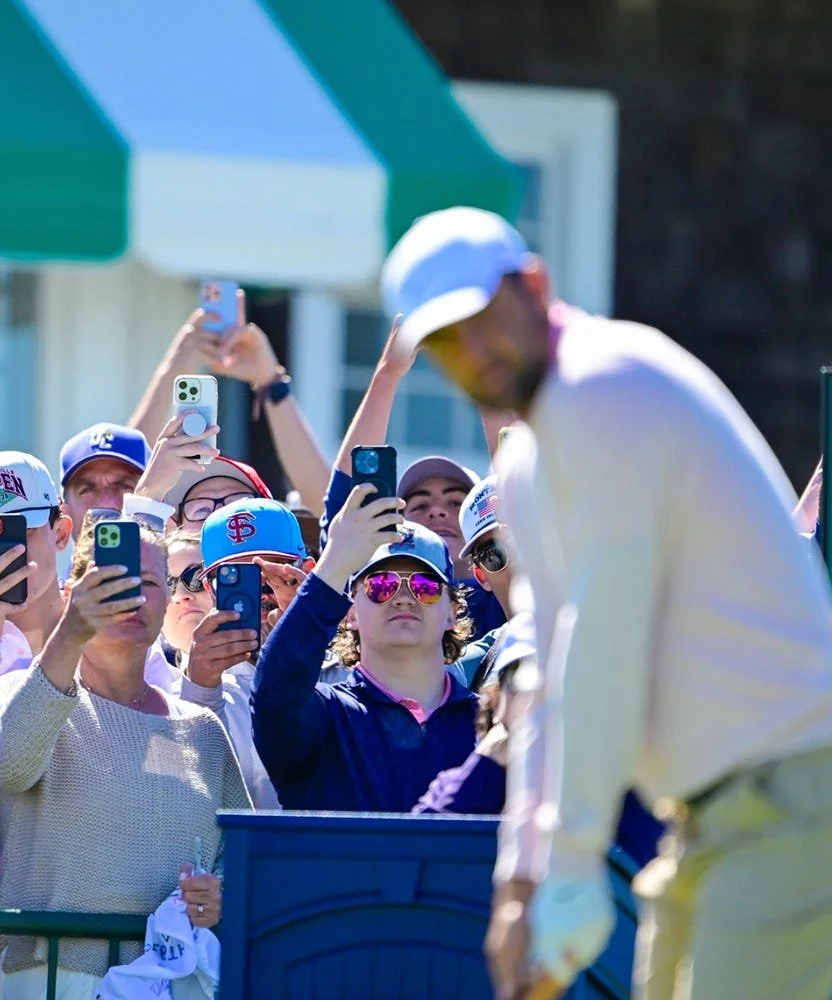
Every access point restricted. Every access point controlled by the Masters.
Here’s what those few days look like in numbers.
Merchandise sales for tournament week: about $70 million. That’s $10 million a day, $1 million an hour, $277 a second.
The $50 gnome: 1,000 per day, one per person. It sells out within an hour of gates opening and resells for $1,000. The $575 Masters board game set resells for $7,500. Average spend per patron: an estimated $1,000.
And hear me out: there is no online store.
Only the people who walked through those gates in April. Only that week.
That’s how merchandise came to account for nearly half of this tournament’s annual revenue. The biggest business unit of the most prestigious golf tournament in the world is, in effect, a souvenir shop.
Limited Access, Limited Edition. You must be there to buy (limited access). Being there doesn’t mean you get one (limited quantity). Plus total control over what leaves the grounds. The photos, videos, everything.
Most brands are afraid to pull even one of these levers. Revenue would evaporate. Their views will be gone. Yet the Masters pulls all of them. Which is why a single piece of Masters merch works as status among golf fans. Within golf, it out-scarces Hermès.
That limited access and limited editions trigger desire is not anything new. Hermès does it. Supreme built an empire on it. The real question is, why is this getting stronger in the AI era?
Two reasons.
First, scarcity is a relative value. As the supply around you grows, the price of anything finite rises automatically. And AI is a technology for supplying near-infinite digital versions of content, products and experiences. The more AI floods the world, the bigger the Masters’ scarcity premium grows, without Augusta lifting a finger.
Second, digital scarcity no longer exists. “Limited edition” is one click away from a re-issue. That is how NFTs collapsed. The only verifiable scarcity left is physical. A gate you walk through. A week that opens once a year. A sellout that happens in front of your eyes. The Masters’ double lock is a kind of scarcity AI cannot fake.
The deeper the world goes into infinite copies, the more the uncopyable appreciates.
And this isn’t just about merch. It’s the tournament itself. The Masters happens once a year. Six days, counting everything. The event itself is a limited edition. Anticipation itself is now an industry, and it has value.
But something is still missing from this picture.
The world is full of expensive things you can’t get. Hermès bags. Michelin reservations. But wanting something and loving something are different things. Losing your mind over it is different again. People don’t just want the Masters. They love it. They wait for April. And for one week a year, they go a little crazy. Scarcity alone can’t explain that.
Which brings us to the last element. The one that grows more valuable precisely because AI cannot replace it.
Tradition.
3. Trad Is Back
The real reason people are crazy about the Masters is tradition. And this is their most viral content.
On Wednesday, the day before the tournament, Augusta holds the Par 3 Contest. The best players on the planet dress their small children in caddie jumpsuits and walk the course holding their hands. A day where family, not competition, is the point.
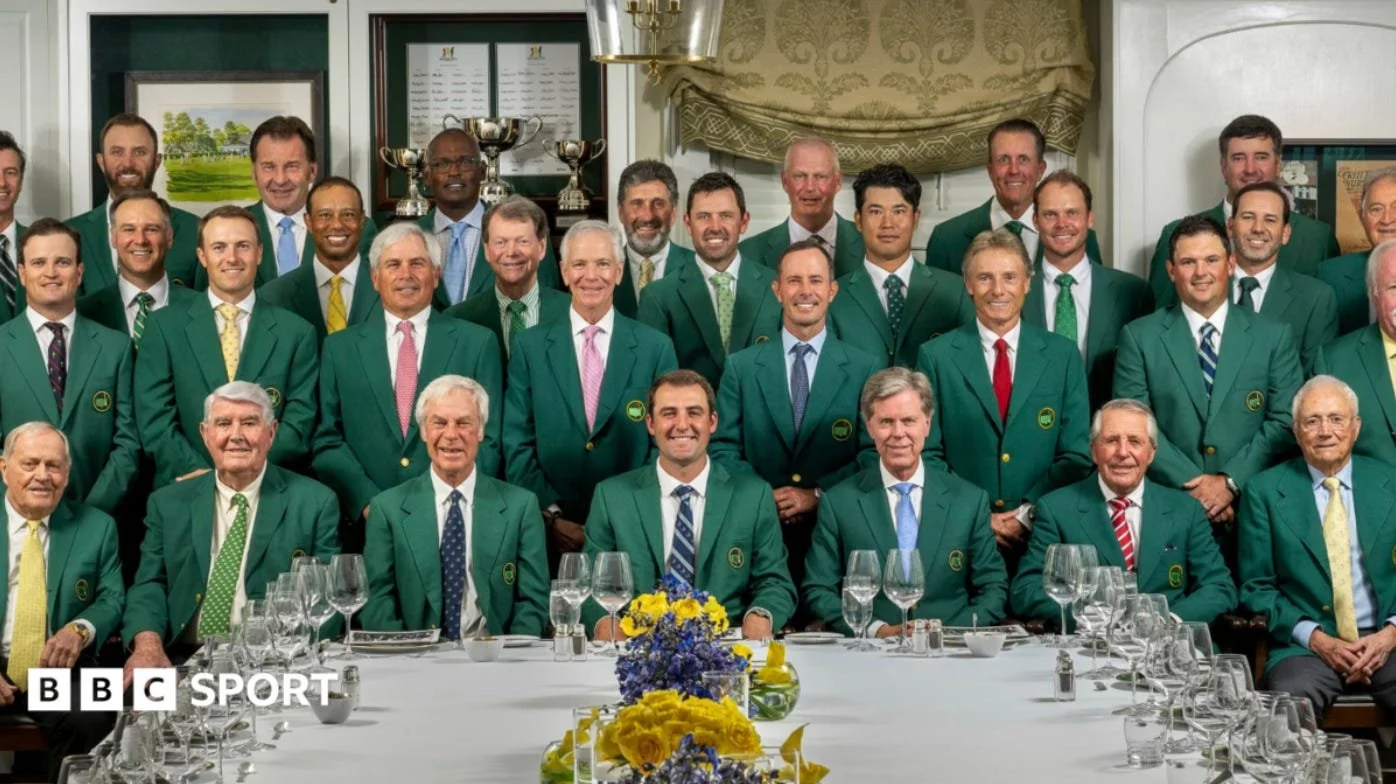
The caddies all wear white jumpsuits. The champion receives the green jacket. Since 1949. The person who helps the new champion into it is last year’s champion. Also tradition. And the champion hosts the next year’s Champions Dinner.
(image: BBC Sport)
A dinner for Masters champions only. The new winner sets the menu. Since 1952.
Now for the fun part. In recent years, the Champions Dinner menu goes viral every single spring. This year was Rory McIlroy’s turn: elk sliders, wagyu filet mignon, sticky toffee pudding, and a dish inspired by his mother’s cooking. The moment the menu drops, the golf internet flips. People judge how well each champion curates his dinner. Recipe recreations flood every feed.
Six years ago, most people had no idea the Champions Dinner existed. Social media turned a 70-year-old tradition into global content.
Stop and look at that for a second. Did the social media and AI era kill tradition? No. It turned tradition into content. More precisely: it became content because it was tradition.
Every company worships efficiency. Consultants like me built the KPI nonsense (I apologize). The AI era made this easier than ever. We even measure the new technology itself in KPIs: tokens, parameters, benchmarks. How optimized. How efficient.
None of it explains the Masters. The Masters is not optimized. It is not remotely efficient.
Blind the name and ask an AI: “Here’s a tournament that operates like this. As a consultant, suggest improvements.”
The AI will oppose everything the Masters does.
Charge rights to broadcast in fees. Open an online store. Raise ticket prices. Sell more ads. Allow phones and maximize reach.
All of it is correct. Yet the moment the Masters follows the advice, the Masters will lose its value.
Why can’t AI build a Masters? How could AI not be supportive of the Masters strategy? One of the most prestigious sporting events on Earth?
The answer is in how AI learns. AI learns from data, and data is the average of the past. So AI’s advice always converges on the industry’s right answers: best practices. Optimization is, by nature, walking toward answers other people have already validated.
AI optimizes what can be measured. The Masters spent 90 years accumulating what cannot be measured. Legacy. Belonging. Tradition.
There are variables AI cannot compute: the value of conviction and tradition. And algorithms don’t spread what is new. They spread what is different. In an era when everything is new, the old, inefficient things look the most different of all.
In the AI era, output is instant. So people fall for what makes them wait.
In the AI era, everything is accessible. So people fall for what is hard to access.
In the AI era, the new arrives daily. So people fall for tradition.
The Masters is becoming the most precious major of the AI era for these reasons. It is the hardest to access, the most analog, and the most stubborn about its traditions of any tournament alive.
Conclusion: Create a tradition
So what do we do with this? We’re young. The AI era has barely started.
Do you, does your company, have anything that repeats and compounds every year?
The thing you keep while everyone else optimizes. The thing you repeat while everyone else pivots. It looks pointless now. Stack it for ten years and it becomes an asset nobody can copy.
Three lessons from the Masters.
One. Create a tradition.
It will take time. You’ll have deadlines that can’t wait. Fine. Deliver those, and stack the tradition alongside them.
Keep making something, and keep showing it to people. Write. Film. Publish. If nothing else, keep a diary. Repeat the same thing, the same way, and let it evolve.
The Champions Dinner was just a dinner in year one. Repetition becomes ritual. Ritual becomes tradition. That is the groundwork that shines brighter as the AI era matures.
The clearest recent showcase of tradition’s power might be the conference. Conferences were devastated after COVID. Now the AI era is reopening their golden age. Nvidia’s GTC, nicknamed “the Woodstock of AI,” has grown its stage every year since the pandemic, and the corporate events market is projected (by industry estimates) to nearly double by 2029. If you’ve read this far, you know why. When everything can be summoned with a click, the one gathering that happens in person, once a year, is the one people wait for.
The beauty of tradition lies in the beauty of waiting.
Make an annual event. A monthly one. A weekly one. Create a tradition. In the AI era, the winner is whoever can make people anticipate and wait.
Two. Restriction is power.
Limits on access. Limits on purchase. The AI era opens access to everything: ask and it answers, click and it opens. Which is exactly why, to shine here, you go the other way. Become the one who gates access.
Learn to restrict and control. Sometimes, you have to be a bottleneck on purpose.
Three. Build a universe.
Obsess over your branding. This takes time too. But it is territory AI cannot take. Obsess over the small things: your tagline, your slogan, your catchphrases, your color. They can change later. They can evolve. But right now, obsess over it. Branding yourself so consistently that someone calls it crazy. That’s a universe that AI cannot replace. Like Augusta refusing to let anyone say “fans.” That crazy obsession is what makes crazy fans.
AI can make anything new. The one thing it cannot make is something old.
If you want to win in the AI era, create a tradition.
— Jae Kim, ai storian